


Quick-Glia™ Microglia – Human iPSC-Derived Microglia (Healthy Donor)
Quick-Glia™ human iPSC-derived microglia are off-the-shelf microglia that provide a consistent, biologically relevant in vitro model for studying human microglial biology and disease. These cryopreserved, ready-to-use iPSC-derived microglia mature rapidly and deliver reproducible performance for drug discovery, toxicity screening, and neurodegenerative disease research.
$1,100.00
Out of stock
Advantages of iPSC-Derived Microglia
Human iPSC-derived microglia are brain-resident immune cells differentiated in vitro from induced pluripotent stem cells (iPSCs), offering a scalable and human-relevant model for neuroimmune research. These cells provide several advantages over other in vitro microglia models:
Rapid Differentiation
~1 week
Functionally Validated
QC confirmed
Highly Pure Population
IBA1+, TMEM119+
No Genetic Footprint
0 modifications
iPSC-Derived Microglia Protocol
Explore our detailed iPSC-derived microglia protocol, a step-by-step workflow designed to support efficient differentiation, maturation, and experimental use of iPSC-derived microglia cells in culture.


Microglia morphology is confirmed via phase contrast imagery: Representative images of Quick-Glia™ Microglia – Human iPSC-Derived Microglia on days 1-7 post-thaw (scale bars = 100 μm).
iPSC-Derived Human Microglia Characterization
Rigorous characterization ensures the identity, purity, and functional relevance of iPSC-derived human microglia. Quick-Glia™ microglia are validated using established molecular, morphological, and functional assays that define human microglial identity and function.
Microglia Marker Expression
Canonical microglial markers are used to confirm the identity of human iPSC-derived microglia in culture.

iPSC-derived microglia express microglial markers and display typical morphology. Immunofluorescent staining of Quick-Glia™ – Human iPSC-Derived Microglia culture shows cells with typical amoeboid morphology and expression of AIF1 (magenta) and TMEM119 (green) on day 7 post-thaw (scale bars = 100 μm).

RT-PCR analysis of marker expression in Quick-Glia™ Microglia – Human iPSC-Derived Microglia. Expression levels of CD45, CD68, CD44, AIF1, P2RY12, CX3CR1, and TREM2 were measured in iPSCs (baseline), differentiated microglia at day 8 post-thaw, and differentiated microglia without cryopreservation. Increased expression in both differentiated conditions confirms microglial identity.
Functional Validation of iPSC-Derived Microglia
Phagocytosis is a defining function of microglia and a key indicator of physiological relevance in vitro. Functional validation of Quick-Glia™ human iPSC-derived microglia is performed using pHrodo-based phagocytosis assays.
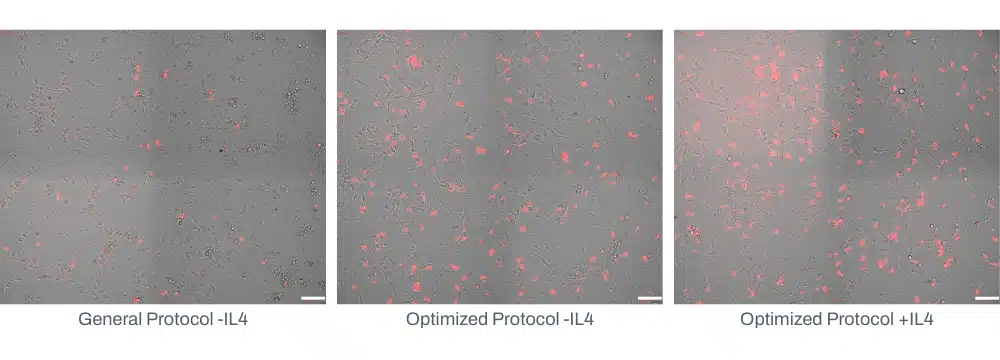
Functional validation of iPSC-derived microglia via pHrodo assay. Representative fluorescence microscopy images showing phagocytosis of pHrodo-labeled particles by Quick-Glia™ Human iPSC-Derived Microglia on Day 6 post-thaw. Increased intracellular fluoresnece indicates successful engulfment and acidification, confirming phagocytic activity (scale bars = 100 μm).
Product Specifications
| Parameters | Specifications |
|---|---|
| Product Name | Quick-Glia™ Microglia - Human iPSC-Derived Microglia |
| Catalog No. | MG-SeV-HC-CW50065 |
| Product Components | Cryopreserved cells, Component MG1, Component MG2, and Component MG3 |
| Starting Material | iPSCs derived from peripheral blood mononuclear cells (CIRM line CW50065) |
| Storage Conditions | Frozen cells should be stored in liquid nitrogen (vapor phase). The rest of the components should be stored at -20°C. |
| Cell Type | Microglia |
| Culture Type | Feeder Cell-Free |
| Disease | Healthy Donor |
| Donor Sex | Female |
| Donor Age at Sampling | 74 |
| Donor Race Ethnicity | Caucasian, not Latino |
| Patient History | See Resources for more information. |
| Reprogramming Method | Episomal vector |
| Induction Method | Transcription factors delivered by Sendai virus |
| Growth Properties | Adherent |
| Number of viable cells | > 1.0 million viable cells per vial upon thawing |
| Cell viability and remaining live cells |
>50% at day 1, >211 live cells per mm² >50% at day 7, >211 live cells per mm² |
| Differentiation |
>75% IBA1 positive cells, >50% TMEM119 positive cells |
| Sterility | No growth observed |
| Mycoplasma | No mycoplasmal enzymes detected |
| Morphological Observation | Cells are adherent and display morphology consistent with microglial identity, including small cell bodies and cytoplasmic processes. |
| Restricted Use | For research use only. Not for use in diagnostic or therapeutic procedures. |
Microglia Resources
2026 Product Catalog
High-Throughput Screening of FDA-Approved Compounds Identifies Modulators of Phagocytic Activity in iPSC-Derived Microglia (SfN 2025)
Patient-Derived iPSC Neuronal Models Reveal Alzheimer’s Disease-Associated Pathology and Provide a Platform for Drug Discovery (SfN 2025)
Quick-Glia™ Microglia – Maintenance Medium
Quick-Glia™ Microglia – Human iPSC-Derived Microglia
No results found.
Related Products
Related products

FAQs
What applications are iPSC-derived microglia used for?
Human iPSC-derived microglia are widely used in applications including neuroinflammation research, neurodegenerative disease modeling, drug discovery, toxicity screening, and microglia–neuron or microglia–astrocyte co-culture systems. Their reproducibility and human relevance make them well suited for both academic and translational research.
Are these off-the-shelf microglia ready to use after thawing?
Yes. Quick-Glia™ human iPSC-derived microglia are cryopreserved and delivered as off-the-shelf microglia that can be thawed and plated directly into culture. The cells mature rapidly post-thaw and are ready for functional assays within approximately one week, streamlining experimental timelines.
How do iPSC-derived microglia compare to primary microglia?
Compared to primary microglia, iPSC-derived microglia offer greater consistency, scalability, and experimental reproducibility. While primary microglia are limited by donor variability and availability, human iPSC-derived microglia provide an off-the-shelf alternative that enables standardized assays, repeatable workflows, and reliable data generation across experiments.
What are iPSC-derived microglia?
iPSC-derived microglia are human microglial cells generated from induced pluripotent stem cells (iPSCs). These cells recapitulate key molecular, morphological, and functional characteristics of human microglia, making them a powerful in vitro model for studying microglial biology, neuroinflammation, and neurodegenerative disease.
No results found.