


Quick-Neuron™ Dopaminergic – Human iPSC-Derived Neurons (Healthy Donor)
Quick-Neuron™ Dopaminergic are cryopreserved, ready-to-use human iPSC-derived dopaminergic neurons that provide a consistent, biologically relevant in vitro model of human dopaminergic neuronal function. These off-the-shelf human iPSC-derived dopaminergic neurons are generated using a proprietary mRNA-based reprogramming method, ensuring rapid maturation and a genetic footprint-free workflow. Ideal for Parkinson’s disease modeling, dopamine signaling studies, neurodegenerative disease research, drug discovery, and neurotoxicity screening, Quick-Neuron™ Dopaminergic delivers reproducible performance across neuronal network activity assays and downstream characterization workflows.
$1,100.00
Advantages of iPSC-Derived Dopaminergic Neurons
Rapid Differentiation
~7 days
Functionally Validated
QC confirmed
Highly Pure Population
TH+, TUBB3+
No Genetic Footprint
0 modifications
Dopaminergic Neuron Protocol
Our step-by-step protocol guides the efficient and reproducible differentiation of dopaminergic neurons from human induced pluripotent stem cells (iPSCs). Designed for ease of use, this protocol supports robust neuronal induction and maturation, helping researchers generate physiologically relevant dopaminergic populations for disease modeling and drug discovery.


Day 1


Day 2


Day 3


Day 6
Dopaminergic neuron morphology is confirmed via phase contrast imagery: Representative phase contrast images of Quick-Neuron™ Dopaminergic – human iPSC-derived neurons on days 1-6 post-thaw.
Dopaminergic Neuron Characterization
Quick-Neuron™ Dopaminergic – Human iPSC-Derived Dopaminergic Neurons undergo rigorous characterization via immunofluorescent staining for key dopaminergic neuron markers. This process confirms cell identity, purity, and functionality to ensure reliable performance in downstream applications such as disease modeling and neurotoxicity screening.
Dopaminergic Neuron Marker Expression
Characterization of Quick-Neuron™ Dopaminergic includes immunofluorescent staining for tyrosine hydroxylase (TH), the pan-neuronal marker TUBB3, and nuclear staining with Hoechst 33342. This combination confirms dopaminergic identity, neuronal lineage, and cell count, supporting confident use in applications such as disease modeling, drug screening, and neurotoxicity assessment.
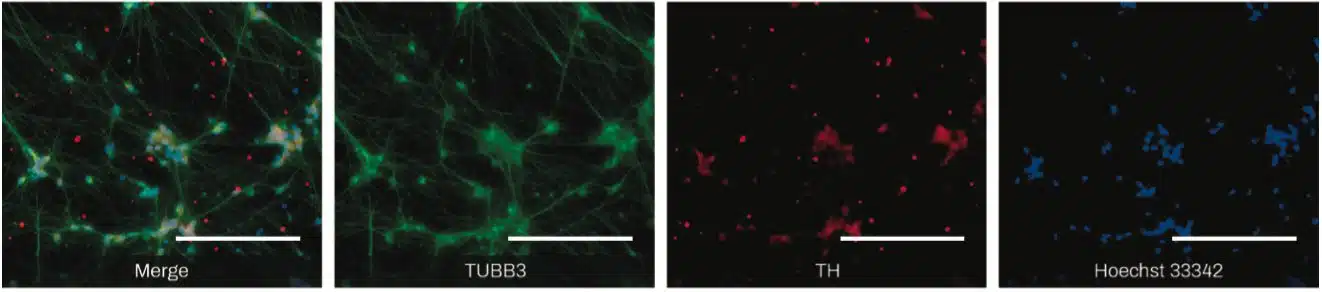
iPSC-derived dopaminergic neurons express neuronal markers and display typical neurite growth. Immunofluorescent staining of Quick-Neuron™ Dopaminergic – mRNA Kit cell cultures shows typical neurite growth and expression of the pan-neuronal marker TUBB3 and the dopaminergic neuron-specific marker TH on day 7 post-differentiation. Nuclei were counterstained with Hoechst 33342. (scale bars = 100 μm).
Product Specifications
| Parameters | Specifications |
|---|---|
| Product Name | Quick-Neuron™ Dopaminergic - Human iPSC-Derived Neurons |
| Catalog No. | DA-mRNA-HC-CW50065 |
| Product Components | Cryopreserved cells, Component N, Component P, Component D4, Component D5, and Component D6 |
| Starting Material | iPSCs derived from peripheral blood mononuclear cells (CIRM line CW50065) |
| Storage Conditions | Frozen cells should be stored in liquid nitrogen (vapor phase). The rest of the components should be stored at -20°C. |
| Cell Type | Dopaminergic Neurons |
| Culture Type | Feeder Cell-Free |
| Disease | Healthy Donor |
| Donor Sex | Female |
| Donor Age at Sampling | 74 |
| Donor Race Ethnicity | Caucasian, not Latino |
| Patient History | See Resources for more information. |
| Reprogramming Method | Episomal vector |
| Induction Method | Transcription factors delivered by synthetic mRNA |
| Growth Properties | Adherent |
| Number of viable cells | > 1.0 million viable cells per vial upon thawing |
| Cell viability and remaining live cells |
>50% at day 1, >211 live cells per mm2 >50% at day 7, >211 live cells per mm2 |
| Differentiation |
At day 7 post-differentiation (CW50065) >80% TUBB3+, >50% TH+/TUBB3+ |
| Sterility | No growth observed |
| Mycoplasma | No mycoplasmal enzymes detected |
| Morphological Observation | Cells are adherent and neurites exhibit substantial outgrowth, elongation and branching, indicative of a differentiated phenotype. |
| Restricted Use | For research use only. Not for use in diagnostic or therapeutic procedures. |
Dopaminergic Neuron Resources
Quick-Neuron™ Dopaminergic – Human iPSC-Derived Neurons
Induction of specific neuron types by overexpression of single transcription factors.
Synthetic mRNA-based differentiation method enables early detection of Parkinson’s phenotypes in neurons derived from Gaucher disease-induced pluripotent stem cells.
Versatile live-cell activity analysis platform for characterization of neuronal dynamics at single-cell and network level.
Efficient derivation and banking of clinical-grade human embryonic stem cell lines in accordance with Japanese regulations
No results found.
Related Products
Related products
FAQs
Do I need a license agreement for any of Ricoh Biosciences’ products?
No. You don’t need any licence or material transfer agreement (MTA) to use our differentiation kits or iPSC-derived cells. However, please be advised that these products are for research use only.
What kind of transcription factors are used for differentiation induction?
It is a proprietary formulated RNA and cannot be disclosed.
Does Quick-Tissue™ technology leave a genetic footprint?
Sendai virus (SeV) is an RNA virus, so it does not integrate into the genomic DNA. In principle, a foreign gene introduced intracellularly in the form of RNA is quickly translated and expressed because, unlike DNA, RNA does not need to enter the nucleus for forced expression, thereby providing no chance of mutagenesis. This is discussed in the following review paper: Yamamoto, et al., (2009) “Current prospects for mRNA gene delivery.” Eur. J. Pharm Biopharm 71, 484-489.
Will SeV remain active after differentiation?
No. The SeV used in our kits is a temperature-sensitive mutant that is active at 33℃ but becomes inactive at 37℃, which is the temperature instructed in the user guides post-differentiation.
No results found.