

Real-time quantitative PCR analysis of expression levels of sensory neuron-associated genes SCN9A, PRPH, ISL1, and BRN3A were examined. The graph shows comparison of gene expression in Quick-Neuron™ – Sensory mRNA Culture on day 10 with gene expression in Human Dorsal Root Ganglion total RNA (TaKaRa, Catalog Number: 636150). The relative gene expression is normalized to phosphoglycerate kinase 1 (PGK1), and then calculated as a fold induction relative to hiPSCs as a control. Error bars show standard deviation.

Quick Neuron™ Sensory – Human iPSC-Derived Sensory Neurons (Healthy Donor)
Quick-Neuron™ human iPSC-derived sensory neurons are off-the-shelf peripheral neurons that provide a physiologically relevant in vitro model of human sensory neuron function. These cryopreserved, ready-to-use iPSC-derived sensory neurons exhibit characteristic sensory markers and functional responses, enabling reproducible studies of nociception, peripheral neuropathy, ion channel activity, neuroinflammation, and drug discovery.
$1,100.00
Advantages of iPSC-Derived Sensory Neurons
Rapid Differentiation
~1 week
Functionally Validated
QC confirmed
Highly Pure Population
PRPH+, SCN9A+
No Genetic Footprint
0 modifications
Sensory Neuron Protocol
Explore our detailed differentiation protocols, a step-by-step guide designed to simplify and optimize your laboratory procedures using our iPSC-derived cells and differentiation kits. These protocols leverage the latest advancements in iPSC technology to ensure efficient and reproducible results.

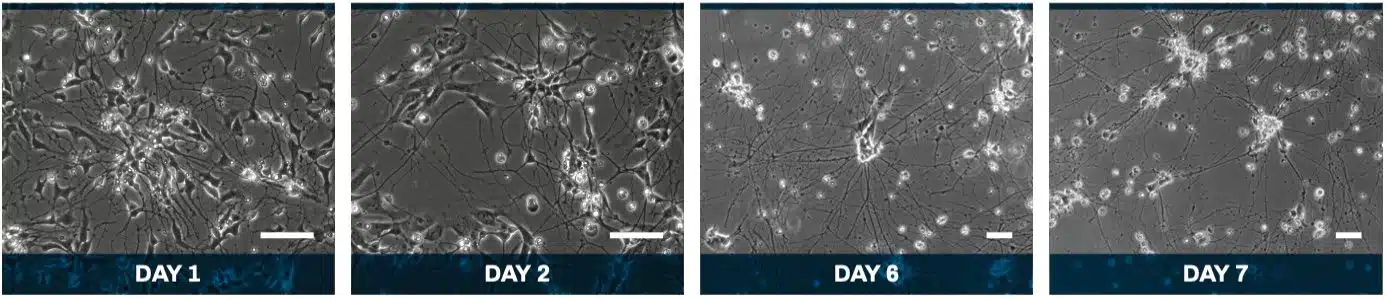
Sensory neuron morphology is confirmed via phase contrast imagery: Representative images of Quick-Neuron™ Sensory – Human iPSC-derived Neurons on days 1-7 post-thaw (scale bar = 100 μm).
Sensory Neuron Characterization
Comprehensive molecular and phenotypic validation confirms the identity, purity, and peripheral lineage specification of Quick-Neuron™ human iPSC-derived sensory neurons.
Sensory Neuron Marker Expression
Immunocytochemical analysis confirms marker expression consistent with a differentiated peripheral phenotype in Quick-Neuron™ human iPSC-derived sensory neurons, supporting their use as a physiologically relevant in vitro sensory neuron model.
(A)

(B)
Merge

TUBB3

SCN9A

Nuclei
iPSC-derived sensory neurons express neuronal markers and display typical neurite growth. (A) Immunofluorescent staining of Quick-Neuron™ Sensory – mRNA cell cultures shows typical neurite growth and expression of PRPH and BRN3A on day 10 post-differentiation. (B) Immunofluorescent staining of Quick-Neuron™ Sensory cell cultures shows typical neurite growth and expression of PRPH and TUBB3 on day 10 post-differentiation (scale bar = 100 μm).
Real-time Quantitative PCR Analysis

Product Specifications
| Parameters | Specifications |
|---|---|
| Product Name | Quick-Neuron™ Sensory - Human iPSC-Derived Neurons |
| Catalog No. | SS-mRNA-HC-CW50065 |
| Product Components | Cryopreserved cells, Component N, Component P, and Component S1 |
| Starting Material | iPSCs derived from peripheral blood mononuclear cells (CIRM line CW50065) |
| Storage Conditions | Frozen cells should be stored in liquid nitrogen (vapor phase). The rest of the components should be stored at -20°C. |
| Cell Type | Sensory Neurons |
| Culture Type | Feeder Cell-Free |
| Disease | Healthy Donor |
| Donor Sex | Female |
| Donor Age at Sampling | 74 |
| Donor Race Ethnicity | Caucasian, not Latino |
| Patient History | See Resources for more information. |
| Reprogramming Method | Episomal vector |
| Induction Method | Transcription factors delivered by synthetic mRNA |
| Growth Properties | Adherent |
| Number of viable cells | > 1.0 million viable cells per vial upon thawing |
| Cell viability and remaining live cells |
>50% at day 1, >211 live cells per mm2 >50% at day 7, >211 live cells per mm2 |
| Differentiation |
>80% TUBB3 positive cells >50% Peripherin positive cells >35% ISL1/ISL2 positive cells among Peripherin positive cells |
| Sterility | No growth observed |
| Mycoplasma | No mycoplasmal enzymes detected |
| Morphological Observation | Cells are adherent and neurites exhibit substantial outgrowth, elongation and branching, indicative of a differentiated phenotype. |
| Restricted Use | For research use only. Not for use in diagnostic or therapeutic procedures. |
Sensory Neuron Resources
Quick-Neuron™ Sensory – Human iPSC-Derived Neurons
Quick-Neuron™ Sensory – mRNA Kit
Transcription Factor-Based Rapid Differentiation of Human iPSCs into Inhibitory, Excitatory and Sensory Neurons (Society for Neuroscience 2022)
2026 Product Catalog
Generation of a Collection of CNS Cells from iPSCs by Quick-Tissue™ Technology
No results found.
Related Products

FAQs
Does Quick-Tissue™ technology leave a genetic footprint?
Sendai virus (SeV) is an RNA virus, so it does not integrate into the genomic DNA. In principle, a foreign gene introduced intracellularly in the form of RNA is quickly translated and expressed because, unlike DNA, RNA does not need to enter the nucleus for forced expression, thereby providing no chance of mutagenesis. This is discussed in the following review paper: Yamamoto, et al., (2009) “Current prospects for mRNA gene delivery.” Eur. J. Pharm Biopharm 71, 484-489.
Will SeV remain active after differentiation?
No. The SeV used in our kits is a temperature-sensitive mutant that is active at 33℃ but becomes inactive at 37℃, which is the temperature instructed in the user guides post-differentiation.
Is Sendai virus (SeV) dangerous?
SeV is not pathogenic to humans (i.e., humans are not the natural host of the virus) and the infection does not persist in immunocompetent animals. Furthermore, SeV used in our kits does not produce infectious viral particles upon transduction to host hPSCs and is a temperature-sensitive mutant, such that it is active at 33℃ but becomes inactive at 37℃. However, because SeV can be transmitted by aerosol and contact with respiratory secretions and is highly contagious, appropriate care must be taken to prevent potential mucosal exposure to the virus. Our SeV-based kits must be used under Biosafety Level 2 (BL-2) containment with a biological safety cabinet or a laminar flow hood and with appropriate personal protective equipment. In the event that the virus comes into contact with skin or eyes, decontaminate the affected area by flushing with plenty of water and follow the safety manual prepared by your laboratory and approved by your Institutional Biosafety Committee.
Do I need a license agreement for any of Ricoh Biosciences’ products?
No. You don’t need any licence or material transfer agreement (MTA) to use our differentiation kits or iPSC-derived cells. However, please be advised that these products are for research use only.
No results found.