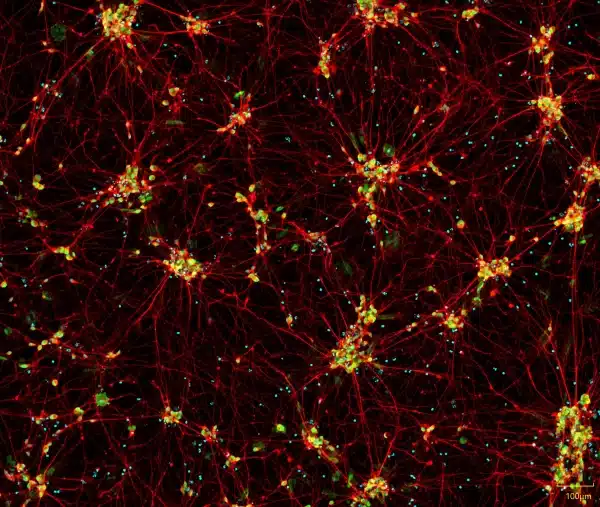
Quick-Neuron™ Sensory – Maintenance Medium

Quick-Neuron™ Sensory – Maintenance Medium is formulated for long-term maintenance of human iPSC-derived sensory neurons in vitro. Designed for research use, this medium supports consistent culture performance for downstream neuroscience and peripheral nerve research applications.

$220.00

Product Specifications

Parameters Specifications
Product Name Quick-Neuron™ Sensory - Maintenance Medium
Catalog No. SS-MM
Product Components Component N, Component S1, and Component P
Storage Conditions All components can be stored at -20°C or -80°C.
Cell Type Sensory Neurons
Shelf Life 1 Year
Sterility No growth observed for Bacteria and Fungus
Mycoplasma No contamination detected
Restricted Use For research use only. Not for use in diagnostic or therapeutic procedures.

Sensory Neuron Resources

Transcription Factor-Based Rapid Differentiation of Human iPSCs into Inhibitory, Excitatory and Sensory Neurons (Society for Neuroscience 2022)

No results found.

FAQs

Do I need a license agreement for any of Ricoh Biosciences’ products?

No. You don’t need any licence or material transfer agreement (MTA) to use our differentiation kits or iPSC-derived cells. However, please be advised that these products are for research use only.

What kind of transcription factors are used for differentiation induction?

It is a proprietary formulated RNA and cannot be disclosed.

Does Quick-Tissue™ technology leave a genetic footprint?

Sendai virus (SeV) is an RNA virus, so it does not integrate into the genomic DNA. In principle, a foreign gene introduced intracellularly in the form of RNA is quickly translated and expressed because, unlike DNA, RNA does not need to enter the nucleus for forced expression, thereby providing no chance of mutagenesis. This is discussed in the following review paper: Yamamoto, et al., (2009) “Current prospects for mRNA gene delivery.” Eur. J. Pharm Biopharm 71, 484-489.

Will SeV remain active after differentiation?

No. The SeV used in our kits is a temperature-sensitive mutant that is active at 33℃ but becomes inactive at 37℃, which is the temperature instructed in the user guides post-differentiation.

No results found.

Contact Us

Have a question about our products, services, or custom projects? Our team is here to help—reach out and we’ll get back to you as soon as possible.

Subscribe

Sign up to our eNewsletter to stay up to date with the latest product launches, promotions, and receive expert tips.

By signing up you are agreeing to our Privacy Policy