


A Data-Driven Approach to Developing Novel Cell Types
Human iPSCs offer vast potential—but only when transformed into mature, reproducible, and physiologically relevant cell types. Ricoh Biosciences’ Novel Cell Type Development service combines transcriptomic data, proprietary transcription factor tools, and functional assays to deliver custom-developed human cells—ready to accelerate your research and therapeutic programs.
Whether you are seeking disease-specific models or new cell types for regenerative medicine applications, we offer customized solutions designed to meet your exact specifications.
How It Works: Our 4-Stage Development Process
Our platform uses omics data analysis, transcription factor engineering, and rigorous assay validation to systematically develop custom iPSC-derived cell types.
Stage 1: Target Phenotype Definition
We define success before we begin.
Each project starts by identifying a molecular and functional benchmark that defines the desired cell type.
Case Example: Dopaminergic Neurons
- Specific markers: Tyrosine Hydroxylase (TH)
- Functional assays: Dopamine release via ELISA
- Target behavior: Rebound firing
This benchmark served as our “north star,” allowing us to track progress objectively through every stage.

Stage 2: Transcription Factor Selection
Precision starts with the right drivers.
Using our proprietary Human Gene Correlation Matrix, we identified transcription factors most tightly correlated with the target phenotype.
Case Example: Dopaminergic Neurons
- We evaluated 7 key markers: TH, DDC, NR4A2, PBX1, CUX2, CALB1, SNCA
- Our selection was based on correlation with primary human Dopaminergic neuron transcriptomes.
- Final transcription factor combination was finalized after testing 10 different transcription factors and 11 different transcription factor cocktail conditions.

Stage 3: Culture Optimization
We fine-tune the culture conditions for maturation.
Once lineage specification is induced, our team optimizes the culture conditions to promote functional maturation.
Case Example: Dopaminergic Neurons
-
Media screens identified conditions promoting the expression of correct dopaminergic neuron markers.
-
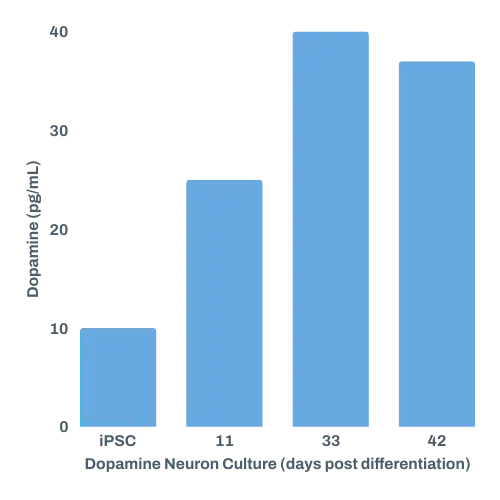
Dopamine expression levels were determined by ELISA from iPSC-derived dopaminergic neuronal culture. Supernatants were collected on days 11, 33, and 42 post-differentiation.
-
qPCR and Immuno Fluorescence Chemistry confirmed gene and protein expression across multiple lots
This iterative refinement ensures that cells aren’t just expressing the right genes—they’re functionally behaving like their in vivo counterparts.
Stage 4: Cell Type Production & Delivery
Once validated, your custom cell type is transitioned into scalable production. Cells are delivered as cryopreserved vials, ready for use in downstream applications and quality-controlled to ensure consistency and reproducibility.
Our team provides continued support throughout your project to help you generate meaningful data and meet your research goals.

Scientific Rigor Meets Speed & Flexibility
With decades of experience in transcription factor biology and stem cell engineering, we’ve built a system that balances scientific robustness with fast turnaround. We work closely with your team to define success criteria and deliver high-quality, human-relevant cell models that move your program forward.
Whether you have a clear target or need help defining the ideal cell type, our collaborative approach ensures that you receive a scientifically validated, high-quality solution tailored for your success.
Let’s build something novel—together.
Request A Consultation
"*" indicates required fields