

Amyotrophic Lateral Sclerosis (ALS)

Custom Assay Services with iPSC-Derived ALS Models
ALS drug discovery has long been limited by models that fail to capture human disease biology. Our iPSC-derived ALS model recapitulates hallmark patient phenotypes, such as TDP-43 mislocalization and motor neuron degeneration. Partner with us to design, optimize, and execute custom cell-based assays that generate meaningful, translational data to drive your research forward.
Why Choose iPSC-Derived Motor Neurons for ALS Models

Physiologically Relevant
ALS models recapitulate disease hallmarks including TDP-43 mislocalization and motor neuron degeneration.

Consistent & Reproducible
Produced under
ISO-9001-certified processes to ensure robust performance and batch-to-batch consistency.

Sporadic & Familial Models
Patient-derived lines from sporadic cases as well as C9orf72, SOD1, and TARDBP mutations for broad disease coverage.

Naturally Evolving Pathology
ALS models exhibit progressive, spontaneous pathology that mirrors in-vivo disease and supports long-term studies.
Modeling TDP-43 Pathology: A Hallmark of ALS
A defining hallmark of ALS pathology is the mislocalization of TDP-43 protein from the nucleus to the cytoplasm, where it forms aggregates that disrupt RNA processing and drive motor neuron degeneration. Ricoh Biosciences’ iPSC-derived ALS models reproduce this key disease feature in human ALS motor neurons, providing a powerful platform for evaluating therapeutic strategies targeting TDP-43 aggregation and localization dynamics.
Visualizing TDP-43 in ALS Motor Neurons
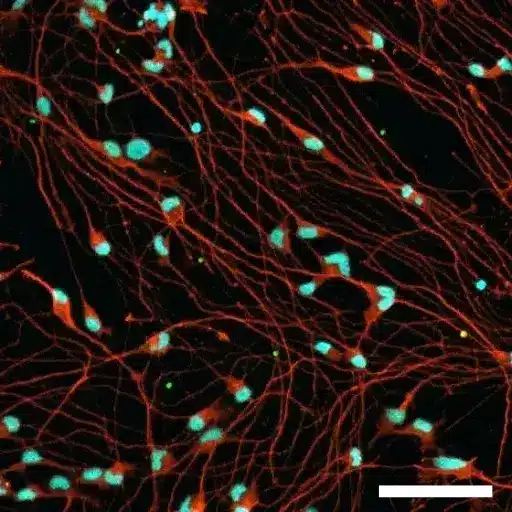
Immunofluorescence imaging of iPSC-derived motor neuron models reveals distinct TDP-43 localization patterns in ALS versus control cultures. In healthy neurons, TDP-43 remains confined to the nucleus, whereas in ALS models it redistributes to the cytoplasm — a defining pathological feature of ALS. This cytoplasmic mislocalization is visible as a yellow signal in the ALS neurons, produced by overlap of TDP-43 (green) with the neuronal marker TUBB3 (red).
Figure 1: Representative immunofluorescence of iPSC-derived motor neurons generated with Quick-Neuron™ from a sporadic ALS donor and a healthy control. Nuclei (blue), total TDP-43 (green), and βIII-tubulin (TUBB3; red). (Scale bars, 100 μm).

Healthy Control

Sporadic ALS

Cytoplasmic Puncta Quantification Across ALS and Control Lines
Quantitative image analysis demonstrates a significant increase in cytoplasmic TDP-43 puncta in ALS cultures relative to healthy controls (****p < 0.0001). This robust and reproducible phenotype supports ALS phenotypic assays and phenotypic screening approaches in a human-relevant system.
Figure 2: Quantification of TDP-43 localization in Quick-Neuron™ motor neurons. Violin plots show the ratio of cytoplasmic to total TDP-43 puncta in cultures derived from a sporadic ALS patient and a healthy control. Significance was quantified by T-test. Stars denote statistical significance: **** = p <0.0001.

Visualizing ALS Model Development: From iPSCs to Functional Motor Neurons
Our ALS cell models begin with patient-derived iPSCs and mature into functional motor neurons with defined electrophysiological and morphological signatures. This standardized workflow ensures reproducible generation of iPSC motor neurons for ALS across studies and compound libraries.
Motor Neuron Differentiation Workflow
Our Quick-Neuron™ workflow reliably generates high-quality motor neuron cultures within days, enabling scalable ALS phenotypic screening and biomarker discovery while maintaining consistency across lots.

Figure 3: Schematic timeline of the Quick-Neuron™ motor neuron differentiation and cryopreservation workflow.
Morphological Maturation and ALS Disease Phenotypes
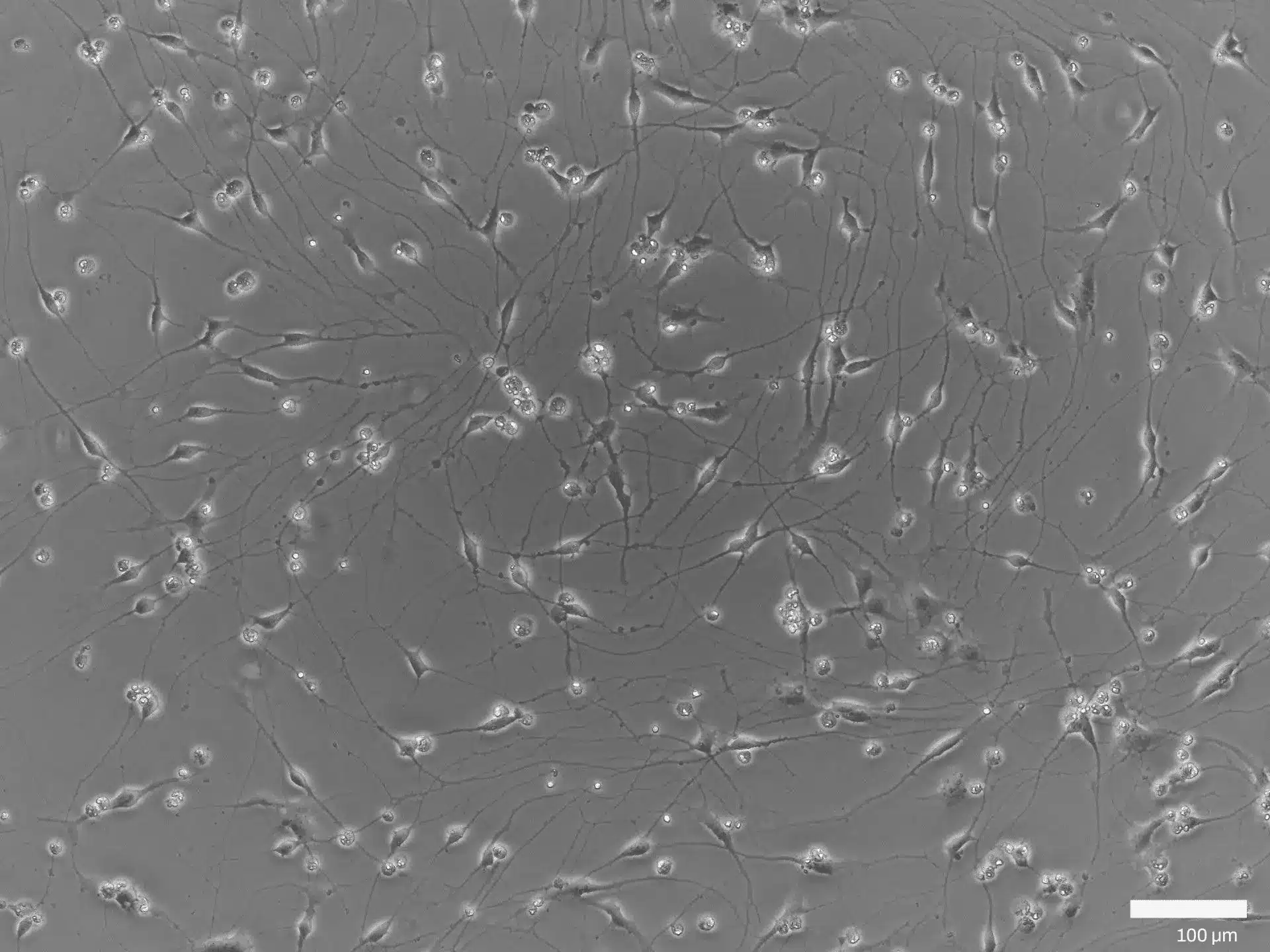
During culture, ALS motor neuron models exhibit reduced survival and neurite complexity relative to healthy controls—phenotypes that emerge progressively and reflect the natural trajectory of ALS-associated neurodegeneration.

Healthy Control


Sporadic ALS

Day 1 (Post-Thaw)

Day 2 (Post-Thaw)
Day 4 (Post-Thaw)

Day 7 (Post-Thaw)
Figure 4: Representative phase contrast images of Quick-Neuron™ motor neurons derived from a sporadic ALS patient and a healthy control on days 1-7 post-thaw. (Scale bars, 100 μm).
Validation Through Marker Expression
Both ALS and control motor neurons express the pan-neuronal marker TUBB3 and motor neuron-specific markers ChAT and HB9, confirming lineage fidelity and successful differentiation. Combined with disease-specific phenotypes, these data validate our iPSC-derived ALS models as biologically accurate and reproducible platforms for ALS research.

Total cell #: 32,811
Healthy Control

96% (31,344/32,811)

86% (26,998/31,344)

74% (18,475/25,134)

Total cell #: 16,210
Sporadic ALS

98% (15,866/16,210)

68% (10,806/15,866)

94% (15,957/17,009)
Hoechst
TUBB3
ChAT
HB9
Figure 5: Immunofluorescence staining of Quick-Neuron™ motor neurons from a sporadic ALS patient and a healthy control. Cultures were stained for the pan-neuronal marker TUBB3 (red), the motor neuron-specific markers HB9 (green), ChAT (green), and nuclei (blue). (Scale bars, 100 μm).
ALS Disease Modeling Services for Drug Discovery & Preclinical Research
Accelerate ALS therapeutic programs using human-relevant ALS disease models purpose-built for neurodegeneration research. Ricoh Biosciences supports programs from early target evaluation through decision-enabling preclinical studies.

ALS-Relevant Cell Models
Deeply characterized human ALS models, including sporadic and familial ALS patient-derived motor neurons optimized for translational research.

Fee-for-Service Assays
Custom ALS phenotypic assays using your compounds to generate high-quality, interpretable data in human motor neurons.

ALS Screening Partnerships
Long-term collaborations to evaluate compounds across disease-relevant phenotypes in ALS drug discovery models.

Preclinical Data Partnerships
Integrated generation of decision-enabling preclinical ALS cell model data packages to support therapeutic advancement.
ALS Research Resources
Modeling ALS Using Patient-Derived iPSCs: A Human-Relevant Platform for Disease Research and Therapeutic Discovery (SfN 2025)
Using ALS Patient-Derived Motor Neurons to Study TDP-43 Mislocalization
Speak with a Scientist About Our ALS Disease Models
Advance your ALS research with Ricoh Biosciences’ expertise in iPSC-derived ALS disease modeling. Our scientists collaborate closely with partners to design, validate, and execute assays that drive ALS drug discovery forward.

Access Our Expertise Through Marketplaces
Connect with Ricoh Biosciences on ScienceExchange or Scientist.com to simplify access to our ALS disease models and assay services.
"*" indicates required fields